Welcome to our first issue of the AI/ML for Genomics & Genetic Counseling Newsletter, now published bimonthly within Perspectives!
Editor: Katya Orlova, MPH, CGC, PhD
Contributing Editors: KT Curry, MS, CGC, Marlena Ahn, MGCS, LCGC, Ping Gong, MS, CGC, Lara Sucheston-Campbell, PhD, MS
Subscribe to the AI/ML Email List for Updates
News & Opinion
Axios, 2025
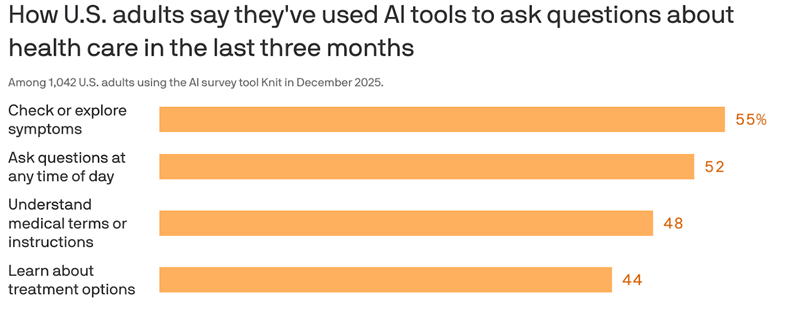
Users turn to ChatGPT to decode medical bills, spot overcharges, appeal insurance denials, and when access to doctors is limited, some even use it to self-diagnose or manage their care. ChatGPT can give wrong and potentially dangerous advice, especially in conversations around mental health. Multiple viral stories highlight how people have uploaded itemized bills to AI for analysis, uncovering errors like duplicate charges, improper coding or violations of Medicare rules. Open access with free subscription.
Tags: Medicine, Chatbots, Insurance
Cajas Ordonez et al, 2025
Current AI systems in health care suffer from overconfidence and inability to express uncertainty, leading to potentially dangerous situations. Effective clinical AI requires embedding epistemic virtues that prioritise responsible uncertainty acknowledgment over confident predictions.
Tags: Medicine, ELSI
Forbes, 2025
Survey of approaches to AI in education around the world. In the U.S., local districts are left to navigate a “Wild West” of tools without clear national guardrails.
Tag: Education
Five Percent, 2025
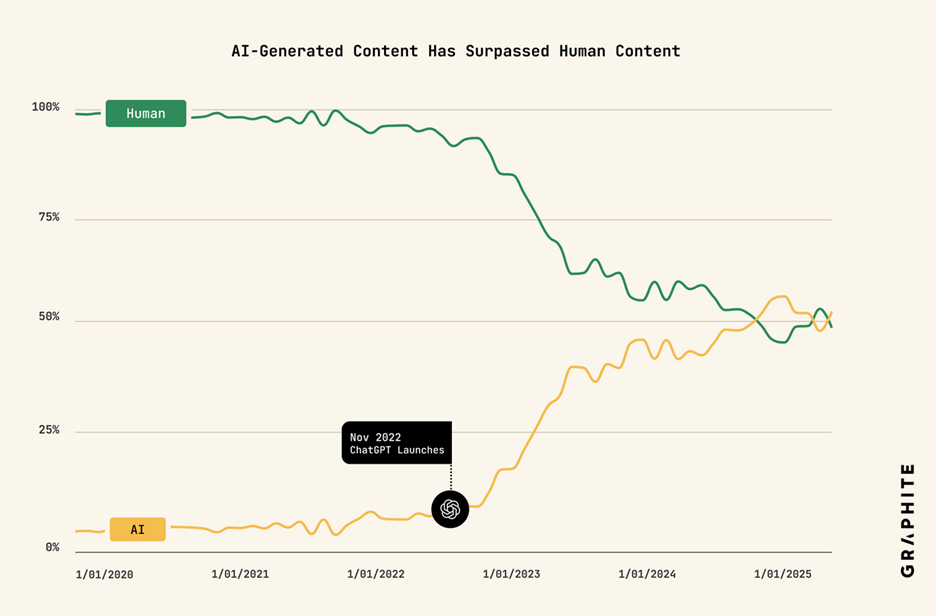
In November 2024, the quantity of AI-generated articles being published on the web surpassed the quantity of human-written articles. However these articles are largely absent from Google and ChatGPT.
Tag: ELSI
RWJF, 2025
Dr. Timnit Gebru is a Stanford PhD graduate in computer vision who spoke out warning of risks of using facial-recognition technology in law enforcement and the potential for abuse when computer vision becomes a surveillance tool. She was famously let go by Google as a result of an article she coauthored about the size, risks and need for ethical oversight of LLMs. She then founded Distributed Artificial Intelligence Research Institute (DAIR) in 2020. DAIR’s mission is twofold: to expose and disrupt the harms of technology and “to cultivate spaces to accelerate imagination and creation of new technologies and tools to build a better future.”
Merriam-Webster, 2025
Merriam-Webster’s word of the year, “slop,” is defined as “digital content of low quality that is produced usually in quantity by means of artificial intelligence.”
 Open access
Research
 Feuer and Holmes et al, 2025
- A few key takeaways from this study
- Readiness and uncertainty: Genetic counseling graduate programs (GCGPs) widely recognize AI/ML’s growing relevance but they vary substantially in preparedness; many leaders report limited exposure, uneven integration and uncertainty about how / how much to incorporate AI/ML into already dense curricula.
- Scope: AI/ML is perceived as most impactful for technical competencies (e.g., genetics expertise, variant interpretation, risk assessment) and least impactful for interpersonal, psychosocial and counseling skills; AI/ML can’t replace human elements of genetic counseling, but may complement it.
- Major barriers to preparedness include lack of faculty expertise, resources, ethical guidelines and accreditation requirements; the authors call for collaborative development of AI/ML-specific competencies, training resources and professional guidance to enable equitable, sustainable integration across programs.
Tag: Genetic Counseling
 Omar et al, 2025
This study evaluated hallucinations arising from fabricated details embedded in prompts that lead the model to produce or elaborate on the false information. LLMs are highly susceptible to such adversarial hallucination attacks and hallucinate up to 82% of the time, frequently generating false clinical details. While prompt engineering reduces errors, it does not eliminate them. The most successful model tested was GPT-4o (23% hallucination rate if mitigation measures are taken) which is no longer the most advanced model available.
Tags: Medicine, Genetic Counseling, Chatbots
Wong, Pan and Caleshu, 2025
- This study discusses how AI could be integrated into genetic counseling, specifically noting that:
- It can help streamline tasks like automating routine screening, summarizing patient histories, providing accessible education and offering interactive support
- There’s a need for ethical implementation, equity, privacy safeguards and careful evaluation to ensure improved access and patient outcomes rather than harm.
Tag: Genetic Counseling
 Li et al, 2025
Health care institutions increasingly rely on cross-institutional collaborations to create predictive models. Researchers create a model-agnostic solution designed to reduce algorithmic bias in such collaborations while preserving patient privacy. In validations using real-world data, this approach improves fairness by 90% without compromising predictive accuracy.
Tag: Disease Prediction
NPR, 2025
Gastroenterologists in Poland appeared to be worse at spotting polyps and other abnormalities during colonoscopies on their own, after they've grown accustomed to using an AI-assisted system. They originally detected 28.4%, but only 22.4% after the AI system was turned off. A similar study has shown that non-experts do a worse job scanning mammograms if they know they can get an AI system to help them. Nevertheless, there’s disagreement among clinicians and researchers about whether this is a true effect or just statistical noise.
Tag: Medicine
 Ahsan, 2025
This narrative review synthesizes insights from 14 studies exploring how AI is being integrated into undergraduate, postgraduate and continuing medical education programs.
Tag: Education
Genomic AI Network, Clinical AI Interest Group, 2025
This webinar is by Joe Zhang from the Artificial Intelligence Centre for Value Based Healthcare and Sophie Ratkai, lead clinical scientist for genomics AI at Guy’s and St Thomas’ NHS Foundation Trust. They shared their work on OncoLlama and GenoLlama, two cutting-edge NLP tools used for cancer history extraction and biomarker profiling from unstructured clinical documentation. The length of this webinar is 51 minutes with up to 2x speed available.
Tag: Medicine, Genetic Counseling, Disease Prediction
Resources
AIM-AHEAD, 2025
NIH’s AIM-AHEAD offers four training programs designed to develop a workforce of researchers from a variety of backgrounds who are proficient in AI/ML and eager to address unmet needs in communities across the United States and its territories. Postgraduates, graduate students, postdocs, health care workers, and early-career researchers are encouraged to apply. Applicants may apply to multiple training programs; however, acceptance is limited to one program. Placement will be determined by scientific and programmatic review, as well as the applicant’s stated preference. Join AIM-AHEAD here.
Tag: Education
Google, 2025
This is a free AI education hub with 3,000 technical modules on transformer architecture and other topics —what Google uses to train teams internally. Browse the course catalog and follow predetermined class paths based on interest or sign up for 10-minute mini-courses.
Tag: Education
JD Supra, 2025
A federal bipartisan AI whistleblower law was introduced in May 2025 and is in its early stages. Employees who report concerns about AI tools in clinical labs and diagnostics may be protected by existing whistleblower laws, listed here.
Tag: Medicine, ELSI
 JMIR, 2025
There is widespread misuse of key AI terms and techniques in medicine, psychology and the social sciences, and more rigor is necessary for quality interdisciplinary studies. For example, the majority of studies in these fields labeled as “prediction” are actually association studies, characterized by the absence of model validation with new or unseen data. The article describes terminological challenges and provides practical recommendations.
Tag: Overview
The Business of Healthcare, 2025
Heather Bassett, chief medical officer at Xsolis, explores how AI is revolutionizing health care operations from streamlining hospital workflows to bridging gaps between payers and providers. She breaks down the culture shifts, trust building and responsible AI practices driving real adoption across health systems. Discover why embracing machine learning isn’t just innovation, it’s survival in modern healthcare. This recording is 30 minutes long with up to 2x speed available.
Tag: Medicine
Want a deeper dive into technical resources?
Visit our AI/ML Resources page for additional courses on python, statistics and other ways to learn more about AI/ML — often for free.
Regulation, Policy, Governance
Donald Trump, 2025
New federal requirement: AI/ML tools used by federal agencies (e.g., NIH, CDC, VA) must meet new “truth-seeking” and “ideological neutrality” requirements, i.e., “prioritize historical accuracy, scientific inquiry and objectivity, and shall acknowledge uncertainty” and “not manipulate responses in favor of ideological dogmas such as DEI.” The order also promotes vendor transparency in LLM documentation.
Tag: ELSI
AMA, 2025
Health systems need formal AI governance. This American Medical Association (AMA) webinar discusses a multidisciplinary governance approach to make AI work for clinicians, care teams, and patients. This webinar is 45 minutes and available for free. See also the associated article and a helpful toolkit with infographics on establishing governance for AI.
Tag: ELSI, Medicine
Healthcare Finance, 2025
The Wellness and Oversight for Psychological Resources Act states that AI will be banned for therapeutic decision-making in therapy or psychotherapy unless overseen by licensed clinicians, but will still be allowed for administrative and supplementary support.
“[lawmakers and professional groups] cited emerging risks of using AI in providing direct therapy treatment. In particular, a recent report in the Washington Post found an AI-powered therapist chatbot recommended “a small hit of meth to get through this week” to a fictional former addict.”
Tags: Chatbots, Medicine
 npj Digital Medicine, 2025
AI interventions in health care can lower costs and improve diagnosis and outcomes, but studies underreport indirect costs, cost of infrastructure, workforce training and long-term maintenance, as well as equity issues.
Tags: ELSI, Medicine
Events
Association of American Medical Colleges, 2026
See all 10 webinar sessions here. The goal of the series is for medical educators to confidently engage with artificial intelligence. One live session remains of the series, entitled “Continuous Professional Development in AI: Building a Lifelong Learning Plan” (Feb. 19), and all past session recordings and slides are available here under “Past Sessions.” See also the recorded videos from their 2024 Season on similar topics. Free.
Stanford Center for Artificial Intelligence in Medicine and Imaging (AIMI), 2026
A new series held on every fourth Tuesday of the month that is a crucial initiative for disseminating the latest AI advancements in medicine, aiming to drive transformative innovations in healthcare. See 2026 talks, including some genetics-focused ones, and recordings of past talks.
ARCH, 2026
Workshop series designed for participants with basic Python or data analysis experience; no prior machine-learning background is required. The goal of ARCH is to support academic and community stakeholders in the adoption of AI/ML tools to advance their health and disease research goals. Zoom link provided upon registration. Feb. 19, 2026, 12:00-1:00 p.m. PST.
Tools & Tips
Google, 2025
LearnLM is a family of models fine-tuned for learning and informed by learning science, and is infused directly into Gemini. This PDF has practical instructions for teachers on how to prompt LearnLM, and can be helpful for other LLMs as well.
Have feedback on our content? Want to share a resource? Have an AI/ML anecdote to share from your field? Contact Us
NSGC AI/ML Subcommittee The AI/ML Subcommittee is part of the National Society of Genetic Counselors’ (NSGC) Genomic Technologies Special Interest Group (SIG). We are dedicated to exploring and advancing the integration of AI and ML technologies to enhance the field of genetics and support the evolving role of genetic counselors.