Recognition and Reimbursement: Widening the Pipeline for Genetic Counselor Employment
Two weeks ago I had the pleasure of reading a thoughtful article in Perspectives - Promise vs. Reality: An Honest Dialogue Between a Recent Graduate and a Program Director About the Genetic Counseling Workforce by Katie Gallagher, MS, CGC and Yalda Safaei, MS, CGC. I appreciate both of them sharing candidly in this article. It is always challenging when highly qualified and hard-working individuals are not employed in the role they trained for. Having been in this profession for more than two decades, I've experienced workforce cycles before, which gives me confidence that our profession will continue to evolve. At the same time, I also recognize—as Ms. Safaei notes—that today's mismatch between graduates and available positions feels unprecedented. Additionally, from the perspective of a program director, Ms. Gallagher asserts, “If we do nothing, the market will eventually decide for us.” Yes, indeed.
For any profession, there is a pipeline and it starts for many with graduate or professional programs. That pipeline narrows (sometimes significantly) from applicants → enrolled graduate students → matriculated students → board certified GCs → employed GCs.
It is ultimately a business proposal on whether a particular institution starts a graduate program or not. And it is ultimately an investment decision on whether a student chooses to pursue a graduate degree or not. In both cases, these are indeed market-driven (or at least market-informed) decisions.
What we can directly influence as a professional society is the bottom of the pipeline where employment occurs. Jobs for genetic counselors - in any capacity, but especially clinical jobs - occur when there is demand. That demand may come from patients. It may come from payers. It may come from other clinical specialties. But what ultimately turns that demand into a smart business decision and a posted FTE genetic counselor position is recognition and reimbursement.
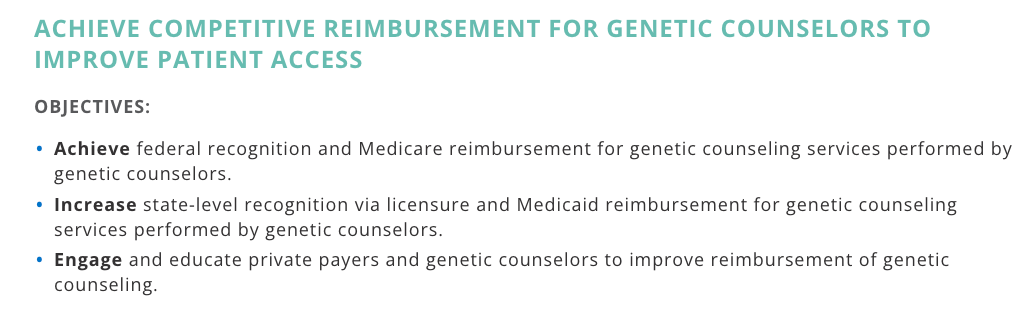
We are a young profession and we are still professionalizing. I know that isn’t a real word, but I am turning it into one. Because professionalization is an action. It is not something that happens to us. It is an action taken by us. A profession is not something we inherit; it is something we build through strategic investment of time, energy, and money, sustained over time. NSGC has a three-year Strategic Plan and the first pillar is all about recognition and reimbursement:
Twenty-five years ago we had no licensure.
We had no profession-specific CPT® code.
We had no coordinated federal advocacy strategy.
Today we have licensure in 40 states, a second-generation CPT® code, and a mature government affairs program that ensures genetic counselors are represented where healthcare policy is made.
A recent example of the advocacy work NSGC is doing to promote genetic counselors as a federally recognized profession is the impact of the RISE final rule on federal student loan limits detailed in my April 2026 column. Since that time, lawsuits have been pursued, and in response, a federal court stayed the implementation and the Department of Education added significantly more professions (namely those involved in the lawsuit) to the list eligible for the higher loan limits. While genetic counselors were not (yet) listed, the court decision made clear what the criteria are for inclusion. We know our profession meets this test, and with the guidance of our government affairs experts at Faegre Drinker, we submitted a letter to the Department of Education on the topic. As always, the letter is available to review on the NSGC Policy Priorities page under Workforce. We recognized a professionalization threat. We acted. The work continues.
Another way to widen the pipeline at the bottom is to advocate for reimbursement. The NSGC Access Committee is a dedicated group of volunteers working directly with payers, both commercial and government (e.g., Medicaid), to ensure genetic counseling by genetic counselors is reimbursed. There are frequent barriers to this. Some are structural (e.g., CPT® code hasn’t been updated to 96041 in their systems), but some are related to professionalization (e.g., lack of licensure in a state). All can be tied to either recognition or reimbursement. When a payer doesn’t recognize genetic counselors as credentialed clinicians, it may not be possible to bill effectively. When an employer such as a university or health system does not deem it worth the time to set up their genetic counselors as billing clinicians, then it makes genetic counselors look like nothing but red ink on a balance sheet. When a genetic counselor doesn’t bill for their full time and work in line with CPT® code 96041 billing guidance, we are not only devaluing the work of that individual, but of the profession as a whole.
When reimbursement improves, genetic counselors move from being viewed solely as an expense to becoming revenue-generating clinicians. That changes hiring decisions. It changes staffing models. It changes whether a position is approved when budgets are tight. Recognition and reimbursement do not guarantee employment, but they fundamentally improve the economics of employing genetic counselors.
Finally, get involved! There is no better way to combat discouragement, frustration, and even occasionally rage than to contribute to solutions. If you are a clinical genetic counselor, work with your administrators and billing staff to ensure every eligible minute is billed, and if it isn’t happening, help figure out what the barriers are. If you have the interest, consider volunteering for NSGC on the Advocacy or Access committees. The Call for Volunteers for 2027 will open in September. If you are a genetic counseling student or genetic counselor, join NSGC. Your membership dues directly pay for this advocacy work and without a strong membership base in NSGC, professionalization will not only stop, but slide backward with less recognition and less reimbursement and therefore fewer jobs in the future. We have good momentum toward professionalization, and your membership is why. Let’s keep that pipeline as wide open as possible so the business decisions made by programs and employers and the investment decisions made by students are positive and easy ones. Let’s go!!
Carrie Haverty, MS, CGC is the President of the National Society of Genetic Counselors (NSGC), where she leads the preeminent organization for genetic counseling professionals in their mission to integrate genetics into healthcare. As a board-certified genetic counselor and clinical leader, Carrie is a dedicated advocate for expanding the impact of the profession and shaping the future of maternal health innovation on a national scale.
In addition to her leadership at NSGC, Carrie serves as the Vice President of Medical Affairs & Clinical Strategy at Mirvie. In this role, she bridges the gap between translational biology and real-world implementation, overseeing the clinical strategy for the Mirvie RNA platform to predict pregnancy complications like preeclampsia.