In this issue of the NSGC AI/ML Subcommittee’s AI newsletter, we cover the newly released NSGC position statement on AI in genetic counseling, an opinion piece debunking myths in AI in genomic medicine and an editorial about clinicians’ role shifting to curators of, and upstream inputs to, AI systems.
We also explore the operational realities of AI integration, such as what clinicians actually edit in ambient AI documentation, global physicians’ adoption of AI and methods to increase AI’s explainability and reduce its bias. We then look at governance, featuring the new 2026 U.S. national AI legislative framework and a comparative policy analysis between the U.S., China, and the EU.
Also included in this issue is a special section looking in depth into clinician expertise and education in the age of AI, discussing concerns such as clinician deskilling (losing previously acquired skills), mis-skilling (learning incorrect information from AI) and never-skilling (trainees failing to ever develop essential competencies). The articles also propose practical solutions to these issues.
 indicates open access
Guest Editor: Ping Gong, MS, CGC
Contributing Editors: Katya Orlova, MPH, CGC, PhD, KT Curry, MS, CGC, Marlena Ahn, MGCS, CGC, Lara Sucheston-Campbell, PhD, MS, Amy Lemke, PhD, MS
Subscribe to the AI/ML Email List for Updates
NEWS & OPINION
THE USE OF ARTIFICIAL INTELLIGENCE IN GENETIC COUNSELING
 NSGC, 2026
NSGC Position Statement on the use of AI in genetic counseling.
“The National Society of Genetic Counselors (NSGC) believes it is essential that genetic counselors guide the responsible integration of artificial intelligence (AI) tools into genomic medicine while maintaining the person-centered approach at the core of genetic counseling practice…” Read the full position statement here.
Tags: Genetic Counseling
ARTIFICIAL INTELLIGENCE IN GENOMIC MEDICINE: DISPELLING THREE MYTHS
 Solomon, 2026
This comment piece explores three myths and controversies involving AI in genomic medicine, including: how clinicians will use AI, whether AI’s impressive on-paper performance will translate to the real world and how patient preferences may or may not impact AI’s transformation of the field.
Based on this discussion, the comment concludes with three recommendations for an AI-based future of genomic medicine: we must continuously learn to understand and use AI, invest in rigorous real-world trials of AI and actively lead the redesign of the healthcare ecosystem to ensure it benefits patients and society.
Tags: Overview
MEDICINE AS AN INFORMATION INDUSTRY IN THE AGE OF LANGUAGE MODELS
Drazen and Haug, 2026
“Medicine is fundamentally an information enterprise in which clinicians integrate patient data with prior knowledge and external sources to guide decisions… LLMs generate fluent, authoritative-seeming outputs based on statistical patterns rather than true understanding, and they have limitations in reasoning, calibration and transparency. As a result, distinguishing evidence-based conclusions from plausible inferences becomes challenging. This shift redefines the role of clinicians and medical journals, which now function both as curators of validated knowledge and as upstream inputs to AI systems.”
Tags: Medicine, ELSI
RESEARCH
INTERPRETABLE FINE-TUNED LARGE LANGUAGE MODELS FACILITATE MAKING GENETIC TEST DECISIONS FOR RARE DISEASES
 Nguyen et al., 2026
Standardizing clinical decisions, such as choosing between gene panels and exome/genome sequencing for rare diseases, is challenging, and traditional machine learning models lack interpretability. To solve this, the researchers developed RareDAI which analyzes heterogeneous clinical data to generate chain-of-thought reasoning before recommending a test. RareDAI outperforms traditional methods and base models like GPT-4 by 10–20%.
Tags: Genetic Testing, Rare Diseases
A QUALITATIVE INTERVIEW STUDY INVESTIGATING PATIENT, HEALTH PROFESSIONAL AND DEVELOPER PERSPECTIVES ON REAL-WORLD IMPLEMENTATION OF PATIENT-CENTERED AI SYSTEMS
 Benda et al., 2026
“Participants identified tensions between explainability and accuracy, varying patient preferences for accessing predictions, and unclear accountability when AI recommendations cause adverse outcomes. Our findings support patient-centered implementation through four strategies: providing professionals with competencies and protected time; engaging stakeholders throughout development; offering flexible communication accommodating diverse health literacy; and establishing multi-layered governance with shared accountability across developers, professionals, and institutions.”
Tags: ELSI, Medicine
WHY HUMAN REVIEW IS KEY TO THE SUCCESS OF AI IN HEALTHCARE
 Yehya, 2026
A new study suggests a process for reducing bias in AI. When an explainable AI(XAI) tool highlights why a model makes certain predictions, it often reveals patterns. Interdisciplinary experts could then ask: Could this pattern be caused by differences in the dataset? Is this result linked to how patients interact with medical devices? Does this reflect a social or structural issue rather than a medical one?
This process helps uncover where AI may be relying on “shortcut features” — patterns that look meaningful but actually reflect bias in the data.
Tags: ELSI, Medicine
WHAT DO CLINICIANS EDIT IN AMBIENT AI-DRAFTED CLINICAL DOCUMENTATION? A QUALITATIVE CONTENT ANALYSIS
 Guo et al., 2026
“The most frequently edited content pertained to clinical facts including orders (eg, procedures, lab tests) (40.0%), symptoms (30.3%), medication prescriptions (27.3%) and diagnosis descriptions (25.9%). In comparison, edits related to terminology use (11.6%) and language style (7.2%) were less frequent…most edits can be categorized into one of the following five types: to revise factual discrepancies, to add medical specialty-specific details, to express diagnostic certainties, to convert patient expressions into objective assessments recorded in medical terms and to reorganize or condense content.”
Tags: Ambient Scribe
GLOBAL PHYSICIAN PERSPECTIVES ON ARTIFICIAL INTELLIGENCE IN HEALTHCARE ACROSS 50 COUNTRIES AND TERRITORIES
 Bold, et al., May 13, 2026
A 2024 global survey of 1,049 physicians across 50 countries and territories revealed a significant gap between AI awareness and real-world usage. While 86.5% of physicians understood AI and 80.2% believed it would improve clinical practice, only 27.8% had actually used it in practice.
Physicians with formal training (only 17.7% of respondents) were more than three times as likely to use AI, and those working in institutions with AI technologies were more than eight times as likely. The gap between awareness and adoption is driven primarily by structural factors: the absence of formal AI training and limited institutional investment in AI technologies.
Tags: International
REGULATION, POLICY, GOVERNANCE
KEY IMPACTS OF THE 2026 NATIONAL AI LEGISLATIVE FRAMEWORK ON HEALTHCARE
 Arnall Golden Gregory LLP, 2026
The authors share the following key takeaways from the national AI legislative framework which was published by the White House on March 20, 2026.
1) A move toward federal AI legislation and potential preemption of state laws.
2) The framework prioritizes innovation alongside safeguards for vulnerable populations.
3) Providers and technology companies should implement mature AI governance now, including inventorying AI assets, tightening oversight, and documenting bias‑mitigation efforts.
Tags: ELSI
A COMPARATIVE TOPIC MODELING ANALYSIS OF AI POLICIES IN HEALTHCARE: INSIGHTS FROM CHINA, THE UNITED STATES AND THE EUROPEAN UNION
 Han et al., 2026
To reveal trends in global healthcare AI policies, this research conducted a comparative topic modeling analysis. "Findings reveal that over the past decade, the three economies have pursued different policy directions in tech orientation, data governance, ethical regulation and service scenarios. China emphasizes application breadth and infrastructure development; the U.S. prioritizes institutional coordination and practical feasibility; the EU underscores risk governance and regulatory frameworks."
Tags: ELSI, International
SPECIAL TOPIC: CLINICIAN EXPERTISE AND TRAINEE EDUCATION IN THE AGE OF AI
AUTOMATION BIAS IN LARGE LANGUAGE MODEL-ASSISTED DIAGNOSTIC REASONING AMONG PHYSICIANS TRAINED IN AI LITERACY — A RANDOMIZED CLINICAL TRIAL
Qazi, et al., 2026
In this single-blind, randomized trial, physicians were split into two groups to evaluate six clinical vignettes. The control group received error-free AI suggestions, while the treatment group received suggestions containing deliberate errors for half of the cases. Despite having completed a 20-hour AI literacy training and the voluntary nature of the tool, physicians exposed to the erroneous LLM suggestions showed significant drops in performance, an adjusted 14.0-percentage-point reduction in diagnostic accuracy (73.3% vs. 84.9% in the control group). The study concludes that substantial automation bias persists even among AI-literate clinicians, underscoring the critical need for robust validation frameworks and regulatory safeguards before widespread AI deployment in clinical settings.
TRUST, SCRUTINY, OR COLLABORATION? A PERFORMANCE-BASED FRAMEWORK FOR HUMAN-AI INTERACTION IN MEDICINE
Zwaan, et al., 2026
The authors argue that Qazi and colleagues’ framing is incomplete, and that, rather than defaulting to uniform skepticism when AI errors occur, physicians must calibrate trust based on two key dimensions: the relative accuracy of humans and AI on a given task, and the degree to which their errors are complementary. The authors propose a dynamic framework featuring four interaction zones — human-dominant, AI-dominant, hybrid review and disagreement resolution — to guide distinct workflows and optimize collaboration as AI and expertise evolve.
PROMOTING CLINICAL EXPERTISE IN THE AGE OF AI: NO STRUGGLE, NO MASTERY
Keren et al., May 7, 2026
As AI transitions from handling basic administrative tasks to formulating diagnoses and treatment plans, medical educators are raising alarms about "never skilling" — the failure of medical students and residents to build the cognitive foundations of clinical expertise because AI provides answers before the necessary mental struggle occurs. Strategies to mitigate these risks include utilizing AI as an "expert consultant" through "commit-then-compare" protocols, adapting AI as a reasoning coach rather than an answer provider, leveraging AI as a "guardian angel" to capture overlooked clinical issues, and establishing strict AI-free learning zones to preserve unassisted critical thinking.
AI-INDUCED NEVER-SKILLING IN MEDICAL EDUCATION
Ke et al., 2026
The authors believe that AI is not inherently harmful to learning; its educational impact depends on how and when it is introduced. To prevent never-skilling, the authors propose a three-phase competency-protective framework: establishing AI-independent baseline competency, building critical calibration through structured pedagogy and integrating AI under supervision in medical training.
WHEN CLINICAL AI AND LEARNER REASONING CONFLICT: AN EMERGING EDUCATIONAL BLIND SPOT AND A FRAMEWORK FOR PEDAGOGICAL RESPONSE
 Heslin, 2026
A pedagogical challenge emerges when AI-enabled clinical decision support (AI CDS) recommendation disagrees with learner clinical judgment. If educators do not address this disagreement appropriately, it may lead to negative educational outcomes.
The author proposes the SEED framework (Surface, Explore, Evaluate, Decide) which provides a structured approach for educators to guide learners through situations in which AI CDS recommendations conflict with learner clinical reasoning.
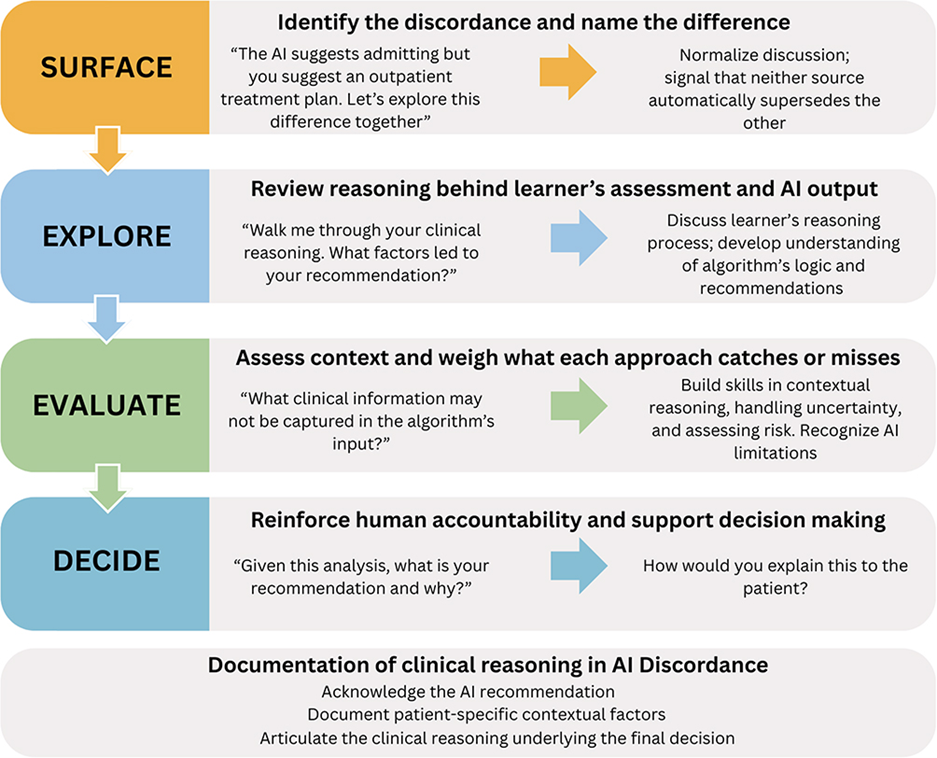
The SEED Framework for Addressing AI-Learner Discordance (Heslin, 2026, Figure 2).
EVENTS
ARTIFICIAL INTELLIGENCE IN MEDICINE: OPPORTUNITIES AND CHALLENGES
Carnegie Mellon University, 2026
On Nov.5, 2026, this full-day conference brings together leaders in AI, medicine, ethics, law and policy to examine where AI systems have delivered value, where they have fallen short, and what is required to responsibly realize their potential to improve the safety, quality, and equity of health care.
Program and other details TBD.
RESOURCES
JAMA+ AI CONVERSATIONS PODCAST
 JAMA
JAMA
This collection of interviews with clinicians, researchers and AI experts explores how AI is impacting medicine. Topics include designing trustworthy clinical AI, AI for drug discovery, AI at the policy table, changing opinions about AI in healthcare, etc.
TRANSPARENCY COALITION.AI
This organization provides a  weekly update of AI-related legislation moving through state legislatures. Open an issue (e.g., May 29, 2026) and search keywords such as “health.” You can also subscribe to their newsletter.
CHATBOTS IN HEALTHCARE: PRIVACY AND AI GOVERNANCE
 Fennessy, Nahra, Nicolazzi and Riella, 2026
In this LinkedIn Live, the speakers unpacked how chatbots are reshaping healthcare, and what that means for privacy, security and governance. This is an hour-long video which is able to be played at two times speed.
Want a deeper dive into technical resources?
Visit our AI/ML Resources page for additional courses on Python, statistics and other ways to learn more about AI/ML — often for free.
Have feedback on our content? Want to share a resource? Have an AI/ML anecdote to share from your field? Contact Us
NSGC AI/ML Subcommittee
The AI/ML Subcommittee is part of the National Society of Genetic Counselors’ (NSGC) Genomic Technologies Special Interest Group (SIG). We are dedicated to exploring and advancing the integration of AI and ML technologies to enhance the field of genetics and support the evolving role of genetic counselors.
NSGC AI/ML Subcommittee The AI/ML Subcommittee is part of the National Society of Genetic Counselors’ (NSGC) Genomic Technologies Special Interest Group (SIG). We are dedicated to exploring and advancing the integration of AI and ML technologies to enhance the field of genetics and support the evolving role of genetic counselors.