Sydney A. Lau, MS, CGC (she/her)
The article below reflects the personal opinions of the author(s) and does not reflect the views or opinions of the Perspectives editors or committee, or the National Society of Genetic Counselors (NSGC).
Article authored and provided by Baylor Genetics as part of a paid partnership with NSGC. The content, views and opinions expressed in this article are those of Baylor Genetics, and do not necessarily reflect the opinions and views of the National Society of Genetic Counselors.
Genome sequencing (GS) is a powerful tool that offers comprehensive sequencing of the genome, covering several variant types, and is useful for patients with a broad differential diagnosis and/or uninformative targeted testing. Several professional societies recommend GS as a first-tier test for patients with complex medical issues and suspected rare diseases.1-3
However, over half of patients with suspected genetic conditions who undergo testing still do not receive a diagnosis.3,4 As a short-read sequencing-based test, GS has limitations on what it can capture. Multimodal approaches paired with GS have demonstrated significant clinical utility across specialties. Laboratories such as Baylor Genetics incorporate additional technologies like optical genome mapping, long-read sequencing, and RNA sequencing to help bridge the diagnostic gap and bring more answers to patients.
Optical Genome Mapping Analysis for Complex Structural Variants
Complex structural variants (SVs) involve multiple deletions, duplications, inversions, and translocations. SVs are clinically relevant and often underrecognized contributors to genetic disease. A significant proportion of patients with undiagnosed rare disease might have SVs that are not readily detected by short-read sequencing.5,6
Optical Genome Mapping (OGM) specializes in the high-resolution detection and characterization of complex SVs.7 OGM uses fluorescent labeling of specific DNA sequences to create predictable banding patterns throughout the genome that are then aligned to a reference sequence for interpretation. OGM can discern the breakpoints, location, and orientation of SVs for more precise clinical management.8
Case Example: OGM Provides Additional Insights for Critically-Ill Newborn
Rapid GS identified an inverted duplication involving chromosome band 3q25 in an infant with seizures, encephalopathy, and hypotonia. These duplications are associated with heart defects, genitourinary malformations, growth delays, and intellectual disability (ID). OGM revealed the inverted duplication was in tandem with an inversion of STAG1, associated with autosomal dominant ID, developmental delays (DD), seizures, and hypotonia. OGM provided a more complete diagnosis for this patient’s symptoms.
Short Tandem Repeat and Methylation Analysis by Long-Read Sequencing
Short tandem repeat (STR) expansions, caused by abnormal increases in the number of repetitive DNA sequences at specific genomic loci, can disrupt gene function and lead to medically-complex and multisystem phenotypes.9 Knowing the precise repeat size often provides information about the expected phenotype and prognosis.
Long-read sequencing (LRS) delivers higher sensitivity for STR expansions compared to short-read sequencing, which requires additional confirmation studies to accurately analyze these repetitive regions.10 LRS can also assess gene expression through methylation analysis without requiring separate targeted assays, which is clinically-relevant for disorders like Fragile X syndrome.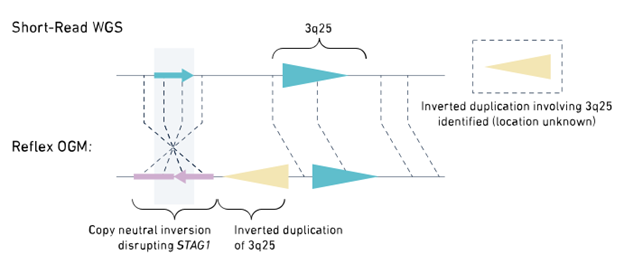
Case Example: LRS Enables Fast and Precise STR Characterization
A pediatric patient with global developmental delay, developmental regression, ataxia, seizures, and a family history of adult-onset Huntington disease underwent rapid GS with polymerase chain reaction (PCR) and was found to have over 200 CAG repeats in HTT, consistent with juvenile-onset Huntington disease. Two weeks later, subsequent Southern blot identified 300-350 repeats. Separately, LRS confirmed 309 repeats were present shortly after the initial GS was completed. LRS can precisely characterize STR expansions while minimizing confirmatory assays for more rapid diagnoses.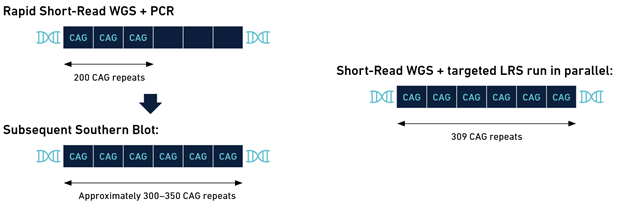
RNA Sequencing as Functional Evidence for Variant Classification
Variants of uncertain significance (VUS) pose a barrier to rare disease diagnosis and clinical management for up to 1 in 5 patients receiving sequencing.11 Splicing variants comprise a significant proportion of disease-causing variants and are often classified as VUS due to challenges with capturing their effects on pathogenicity.12,13 Targeted RNA sequencing (RNA-Seq) offers functional evidence on a variant’s expression at the transcript level, potentially clarifying the impact on splicing and possibly resulting in reclassification and a confirmed diagnosis.
Based on Baylor Genetics’ internal data, approximately 4% of GS samples have at least one variant eligible for RNA-Seq, and up to 50% of eligible variants are reclassified, with the vast majority of reclassifications resulting in an upgrade from VUS towards pathogenic. These results suggest an absolute increase in diagnostic yield for GS with RNA-Seq of 1.6%.14
Case Example: RNA-Seq Leads to More Precise Medical Management
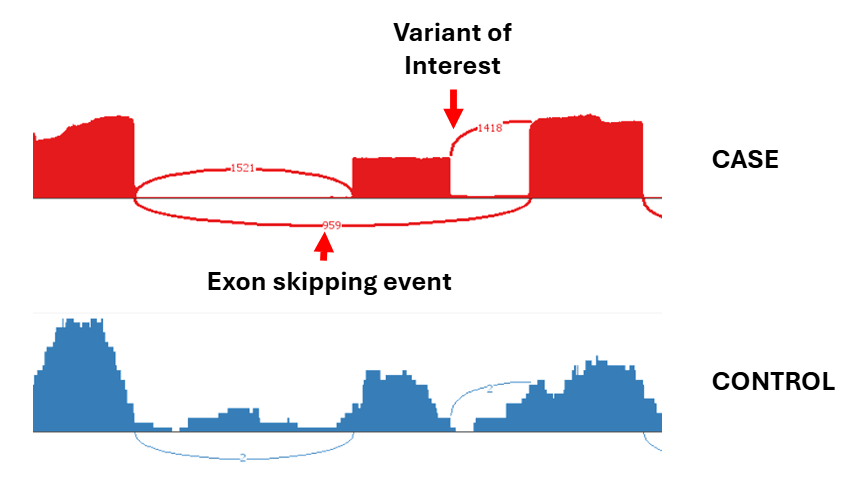
A pediatric ICU patient was admitted for status epilepticus and history of developmental delay, hypotonia, and prolonged QTc interval. Rapid GS identified two CRELD1 variants: one pathogenic and one VUS. CRELD1 is associated with Jeffries-Lakhani neurodevelopmental syndrome, a recently-described autosomal recessive disorder that can include early-onset seizures, hypotonia, global developmental delay, and cardiac abnormalities. RNA-Seq for this VUS showed it causes abnormal splicing and leads to a premature stop codon, providing functional evidence to upgrade the variant to likely pathogenic. Reclassification of this variant resulted in a diagnosis for the patient and provided clarity for their medical management including the avoidance of QTc prolonging agents.
A Multimodal Approach to Genetic Testing
Combined with WGS, advanced technologies like OGM, LRS, and RNA-Seq support short-read sequencing and accelerate a quick resolution to the diagnostic odyssey for many patients that might not receive a diagnosis from WGS alone. Opportunities for early intervention and tailored medical management are increased through this multimodal approach.
References
- Manickam, K., McClain, M. R., Demmer, L. A., Biswas, S., Kearney, H. M., Malinowski, J., Massingham, L. J., Miller, D., Yu, T. W., Hisama, F. M., & ACMG Board of Directors. (2021). Exome and genome sequencing for pediatric patients with congenital anomalies or intellectual disability: an evidence-based clinical guideline of the American College of Medical Genetics and Genomics (ACMG). Genetics in Medicine, 23(11), 2029–2037. https://doi.org/10.1038/s41436-021-01242-6
- Rodan, L.H., Stoler, J., Chen, E., Geleske, T., & the Council on Genetics. (2025). Genetic Evaluation of the Child With Intellectual Disability or Global Developmental Delay: Clinical Report. Pediatrics, e2025072219. https://doi.org/10.1542/peds.2025-072219
- Smith, L., Malinowski, J., Ceulemans, S., Peck, K., Walton, N., Sheidley, B. R., & Lippa, N. (2023). Genetic testing and counseling for the unexplained epilepsies: An evidence-based practice guideline of the National Society of Genetic Counselors. Journal of Genetic Counseling, 32, 266–280. https://doi.org/10.1002/jgc4.1646
- Wojcik, M.H., Lemire, G., Berger, E., Zaki, M.S., Wissmann, M., Win, W., White, S.M., & O’Donnell-Luria, A. (2024). Genome Sequencing for Diagnosing Rare Diseases. New England Journal of Medicine, 390(21), 1985-1997. https://doi.org/10.1056/NEJMoa2314761
- Iqbal, M.A., Broeckel, U., Levy, B., Skinner, S., Sahajpal, N.S., Rodriguez, V., Stence, A., Awayda, K., Scharer, G., Skinner, C., Stevenson, R., Bossler, A., Nagy, P.L., & Kolhe, R. (2023). Multisite Assessment of Optical Genome Mapping for Analysis of Structural Variants in Constitutional Postnatal Cases. The Journal of Molecular Diagnostics, 25(3), 175–188. https://doi.org/10.1016/j.jmoldx.2022.12.005
- Shieh, J.T., Penon-Portmann, M., Wong, K.H.Y., Levy-Sakin, M., Verghese, M., Slavotinek, A., Gallagher, R.C., Mendelsohn, B.A., Tenney, J., Beleford, D., Perry, H., Chow, S.K., Sharo, A.G., Brenner, S.E., Qi, Z., Yu, J., Klein, O.D., Martin, D., Kwok, P.Y., & Boffelli, D. (2021). Application of full-genome analysis to diagnose rare monogenic disorders. npj Genomic Medicine, 6, 77. https://doi.org/10.1038/s41525-021-00241-5
- Levy, B., Burnside, R. D., & Akkari, Y. (2025). Optical Genome Mapping: A New Tool for Cytogenomic Analysis. Genes, 16(8), 924. https://doi.org/10.3390/genes16080924
- Xiao, B., Luo, X., Liu, Y. et al. (2024). Combining optical genome mapping and RNA-seq for structural variants detection and interpretation in unsolved neurodevelopmental disorders. Genome Medicine, 16, 113. https://doi.org/10.1186/s13073-024-01382-9
- Moon, J. (2025). Tandem repeat disorders: from diagnosis to emerging therapeutic strategies. Encephalitis (Seoul, Korea), 5(2), 27–35. https://doi.org/10.47936/encephalitis.2024.00122
- Chintalaphani, S.R., Pineda, S.S., Deveson, I.W., & Kumar, K.R. (2021). An update on the neurological short tandem repeat expansion disorders and the emergence of long-read sequencing diagnostics. Acta Neuropathologica Communications, 9, 98. https://doi.org/10.1186/s40478-021-01201-x
- Rehm, H.L., Alaimo, J.T., Aradhya, S., Bayrak-Toydemir, P., Best, H., Brandon, R., Buchan, J.G., Chao, E.C., Chen, E., Clifford, J., Cohen, A.S.A., Conlin, L.K., Das, S., Davis, K.W., del Gaudio, D., Del Viso, F., DiVincenzo, C., Eisenberg, L., & Rehm, H. (2023). The landscape of reported VUS in multi-gene panel and genomic testing: Time for a change. Genetics in Medicine, 25(12), 100947. https://www.sciencedirect.com/science/article/pii/S1098360023009607
- Baralle, D., & Buratti, E. RNA splicing in human disease and in the clinic. (2017). Clinical Science (London, England: 1979), 131(5), 355–368. https://doi.org/10.1042/CS20160211
- Walker, L. C., Hoya, M., Wiggins, G. A. R., Lindy, A., Vincent, L. M., Parsons, M. T., Canson, D. M., Bis-Brewer, D., Cass, A., Tchourbanov, A., Zimmermann, H., Byrne, A. B., Pesaran, T., Karam, R., Harrison, S. M., Spurdle, A. B., & ClinGen Sequence Variant Interpretation Working Group. (2023). Using the ACMG/AMP framework to capture evidence related to predicted and observed impact on splicing: Recommendations from the ClinGen SVI Splicing Subgroup. American Journal of Human Genetics, 110(7), 1046–1067. https://doi.org/10.1016/j.ajhg.2023.06.002
- Zhao, X., Rigobello, R., Driver, M., Lau, S., Chong, M. L., Chibuk, J., Dai, H., Wu, W. C. W., Peroutka, C., Famularo, L., Kim, A. Y., Hummel, B., Dugan, S., Douglas, T., Meng, L., Xia, F., & Eng, C. M. (2026). Targeted reflex RNA sequencing for enhanced variant classification on exome and genome sequencing improves patient outcomes. npj Genomic Medicine. https://doi.org/10.1038/s41525-026-00571-2
Sydney A. Lau, MS, CGC (she/her) is a certified genetic counselor on the Medical Affairs team at Baylor Genetics. She graduated from the Sarah Lawrence College Joan H. Marks Graduate Program in Human Genetics in 2019 and has experience in pediatric and prenatal genetics clinics in the New York City area. She is passionate about increasing access to comprehensive genetics services and turning peer-reviewed research into real-world solutions for patients.