The article below reflects the personal opinions of the author(s) and does not reflect the views or opinions of the Perspectives editors or committee, or the National Society of Genetic Counselors (NSGC).
Article authored and provided by Natera as part of a paid partnership with NSGC. The content, views and opinions expressed in this article are those of Natera, and do not necessarily reflect the opinions and views of the National Society of Genetic Counselors.
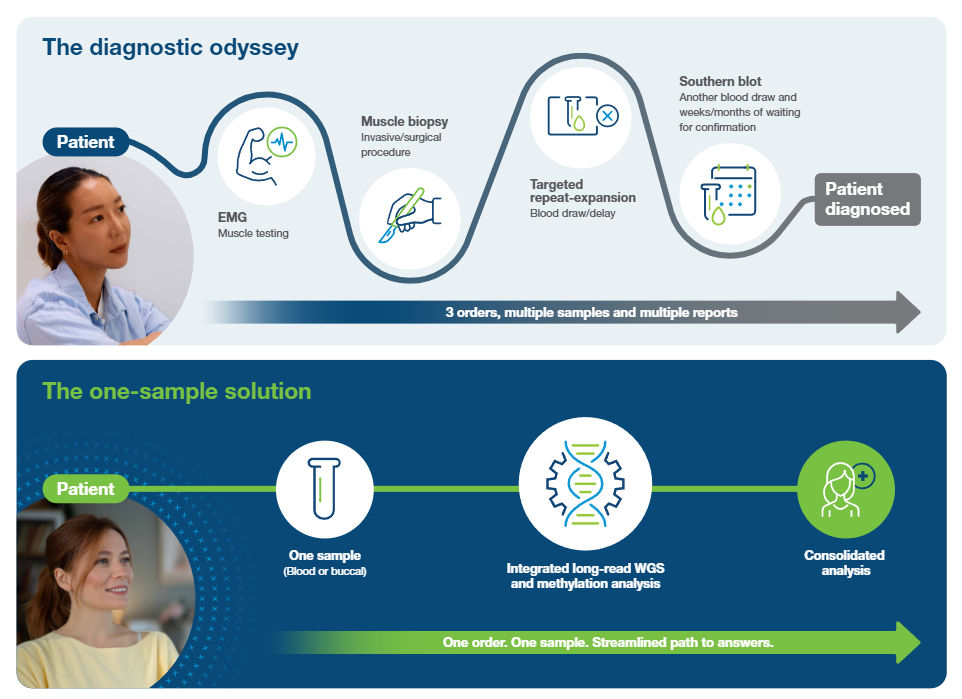
Consider a patient who began noticing muscle weakness and fatigue that slowly disrupts her daily life. Seeking answers, she entered a diagnostic maze: first an EMG, then a muscle biopsy, followed by targeted repeat-expansion testing—each requiring a separate appointment, a new sample, and weeks of waiting. When testing finally identified a DMPK CTG repeat expansion, indeterminate short-read sizing forced yet another step: Southern blot confirmation, meaning yet another sample and another test. By the time she receives a definitive diagnosis, years may have passed across three separate procedures and multiple sample collections. Her journey illustrates a critical need: a single sample could have provided her full answer sooner!
This case is not unusual. Many patients follow a similar multi-sample path to an answer. An integrated long-read whole genome sequencing workflow can simplify this process, generating the sequence data and repeat sizing from one sample. Let’s consider this shift further from two perspectives: the technical capability, and its implications for patients and the genetic counselors (GCs) serving them.
The technology — Why integration changes everything
The diagnostic odyssey many patients experience is now less a science problem than a workflow one. A single sample contains the information needed to answer these questions. In the future, the limiting factor may not be whether an answer can be found in the genome, but the number of separate assays and appointments required to find it.
Large tandem repeats, such as the expansion in DMPK, present a challenge for short-read sequencing. Reads of just 100–150 base pairs cannot span sequences that extend for hundreds or thousands of bases. As a result, these expansions are often missed, undersized, or require an orthogonal method for confirmation.1 Long-read sequencing addresses this limitation directly. Reads long enough to span the repeat allow for accurate sizing and potential allele-level phasing.2
Methylation analysis adds a further layer of information. Without a separate blood draw or distinct assay, methylation signatures can be derived from the long-read data and provide supporting evidence for variant classification or confirmation of imprinting conditions.3
This approach uses one blood draw, one extraction, one sequencing run to power a single, multi-modal pipeline. Instead of managing separate tests, every clinically-indicated result—from variant calling to repeat sizing and methylation—is extracted from data already generated. The collection step remains unchanged; what changes is the sheer depth and breadth of answers one sample can deliver.
The clinical case — What one sample means for patients and counselors
Consider how our patient's experience could have looked–a single blood draw or buccal swab collected and sent to the lab. No invasive muscle biopsy, no second appointment, no separate consent for a second procedure, and no waiting for a Southern blot. The result arrives as a single report: pathogenic repeat detected, phasing, and where relevant, a methylation signature that provides additional evidence for variant classification. The odyssey could collapse into a single clinical event.4,5
The benefits extend far beyond the patient. Family member testing moves faster, and counseling becomes significantly more actionable. While pre-test discussions cover a broader diagnostic scope, post-test conversations have potential to deliver immediate clarity—greater likelihood of an answer rather than a bridge to yet another assay.
The reach of this single-sample approach extends well beyond DMPK. Conditions where methylation analysis is already embedded in clinical practice–Angelman and Prader-Willi syndromes, for example–can be accommodated. Emerging conditions where methylation signatures are beginning to inform variant classification can be incorporated under the same order, from the same tube, without revisiting the collection workflow. The testing expands; the toll on the patient does not.4,6
Access and equity deserve explicit attention here. A standard blood draw in an EDTA tube or buccal sampling is available in most clinical settings: rural health clinics, federally qualified health centers, mobile units, and community hospitals that may not have the procedural infrastructure for muscle biopsies or lumbar punctures. Furthermore, buccal collection can happen in a patient’s home. When a comprehensive diagnostic test requires only phlebotomy or buccal swab, the barrier to entry drops close to zero at the point of collection. The complexity is absorbed by the laboratory, not transferred to the patient or the referring provider.
For providers, the framing is straightforward: order one test, send in one sample. Genetics consultations have been perceived as logistically demanding, as they have required multiple referrals, multiple specimens, and extended time before a clear answer. An integrated long-read WGS workflow reframes that perception. The collection step is already familiar; what has changed is what that one collection might now accomplish.
GCs sit at the center of making this seamless and impactful. Pre-test counseling should include presenting this new framework to patients" Post-test counseling, in turn, is better supported when the result is already comprehensive rather than provisional. The counselor's role does not shrink; it becomes more efficient, more decisive, and more directly connected to meaningful clinical action.
GCs as architects of the next standard of care
GCs have navigated every major transition in this field. From karyotype to chromosomal microarray to short-read genome and beyond. Each step required the same combination of technical literacy, patient advocacy, and the credibility to move payers and health systems. Long-read integrated WGS is the next step on that same arc, and GCs are as well-positioned to lead the transition once again.
The work ahead is not proving out the biology-- the clinical insights from long-read sequencing are clear. What remains is the infrastructure and advocacy — making the case to payers that integrated sequencing is not a luxury but a necessity, educating referring providers that the ordering experience is no more complex than what they already do, and preparing patients for what a truly comprehensive first-line test can offer.
Patients like the one described are still out there, moving through sequential unnecessary workups that one test could have replaced. As GCs move the next wave of innovative genomic testing to standard of care, we may see less and less patients going through years of unnecessary workup, and more patients benefiting from answers from the start.
References
- Tankard RM, Bennett MF, Degorski P, Delatycki MB, Lockhart PJ, Bahlo M. Detecting Expansions of Tandem Repeats in Cohorts Sequenced with Short-Read Sequencing Data. Am J Hum Genet. 2018;103(6):858-873. doi:10.1016/j.ajhg.2018.10.015
- Mantere T, Kersten S, Hoischen A. Long-Read Sequencing Emerging in Medical Genetics. Front Genet. 2019;10:426. Published 2019 May 7. doi:10.3389/fgene.2019.00426
- Fu Y, Timp W, Sedlazeck FJ. Computational analysis of DNA methylation from long-read sequencing. Nat Rev Genet. 2025;26(9):620-634. doi:10.1038/s41576-025-00822-5
- Sabbagh, Q., Gilissen, C., Yntema, H.G. et al. Near-perfect genome sequencing in medical genetics. Nat Genet 58, 1480–1489 (2026). https://doi.org/10.1038/s41588-026-02645-4
- de Bitter et al. Clinical Long-Read Genome Sequencing for Rare-Disease Diagnostics. N Engl J Med 2026;395:405-408 DOI: 10.1056/NEJMc2602512
- Kaplun L, Krautz-Peterson G, Neerman N, Schindler Y, Dehan E, Huettner CS, Baumgartner BK, Stanley C, Kaplun A. ONT in Clinical Diagnostics of Repeat Expansion Disorders: Detection and Reporting Challenges. International Journal of Molecular Sciences. 2025; 26(6):2725. https://doi.org/10.3390/ijms26062725
Brian Schoenfeld, M.S., LCGC is Director of Medical Science for Rare Disease at Natera. He holds an MS in genetic counseling from Arcadia University and spent nearly a decade investigating inherited neurological conditions at the University of Pennsylvania and Albert Einstein College of Medicine. With published research in Alzheimer’s and Fragile X Syndrome, Brian is passionate about bridging molecular pathology and clinical care to transform precision diagnostics for rare disease families.
Lindsay Meyers, M.S., LCGC is Head of Clinical Affairs at MyOme, leading clinical operations, medical science liaisons, and IRB-sponsored research in rare disease. She holds an MS in Genetic Counseling from the University of Utah and brings 15 years of experience in rare disease genomics. Having previously founded the rare disease team at Genome Medical and the pediatric cardiology genetics program at Primary Children's Hospital, Lindsay is dedicated to expanding diagnostic access for families on complex medical journeys.