The article below reflects the personal opinions of the author(s) and does not reflect the views or opinions of the Perspectives editors or committee, or the National Society of Genetic Counselors (NSGC).
Article authored and provided by Ambry Genetics as part of a paid partnership with NSGC. The content, views and opinions expressed in this article are those of the authors, and do not necessarily reflect the opinions and views of the National Society of Genetic Counselors. editors or committee, or the National Society of Genetic Counselors (NSGC).
In the day-to-day practice of genetic counseling, we often incorporate the promise that targeted therapeutics and diagnostics may bring to our families. We talk about ending years-long diagnostic odysseys and tailoring treatments to a patient’s unique genetics, or their tumor profile. But as any genetic counselor (GC) on the front lines knows, a promise is only as good as a patient’s or clinic’s ability to access it.
Today, we should ground ourselves in a difficult reality: access to genomic medicine is not yet equitable. While science is moving at lightning speed, with advances in technology being launched every few months, we watch as important systems lag behind. This includes things like insurance coverage and reimbursement, a hospital formulary, transportation needs, a provider’s preference and even publicly accessible genomic databases. At Ambry, promoting equitable care is not just an initiative; it’s part of our identity and what drives our processes. This all comes together when we remove barriers, when we reinterpret data responsibly, when we support providers and families in test processes, and on the way deliver the genomic medicine to every patient, not just the few.
Defining the "Ramp": Equality vs. Equity
The terms "equality" and "equity" are often used interchangeably, but in a clinical setting, the distinction is critical to our understanding of access to high-quality diagnostics. Equality means giving everyone the same resource, like giving every person in a town a ticket to a baseball game. On paper, everyone has access to the game because it was free. In reality, there are a number of barriers that need to be removed to give every person equal access to the game.
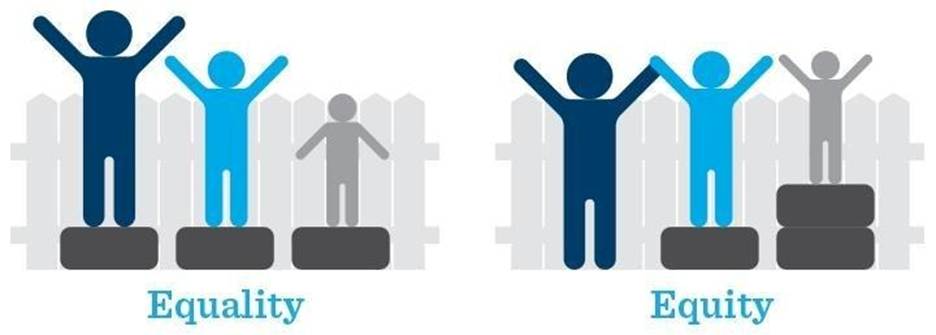
Equity is the act of recognizing that not everyone starts from the same vantage point and adjusting our approach accordingly. It is building the ramp and giving everyone the same chances. In health care, equity is recognizing that, while "everyone has access to a doctor," not everyone has the ability to take unpaid leave from an hourly job for a follow-up, or the time or transportation to reach a specialty clinic.
To bridge this gap, Ambry has focused on three specific pillars of laboratory-driven equity.
1. Decoupling Reanalysis From Socioeconomic Barriers
Genetic testing is not a "one-and-done" event. As we move from "an exome today" to the deeper insights of "an exome tomorrow," reanalysis is the key to discovery. However, traditionally, reanalyses rely on a clinician’s request or a family’s ability to return for follow-up care.
This creates significant disparities. Data shows that clinician-requested reanalysis rates are significantly lower for Black, Asian and Hispanic populations; groups often hit hardest by barriers like medical burnout, transportation issues and lack of specialty access.
Ambry’s Patient for Life program was designed to remove this barrier. By leveraging our dedicated Gene Team to proactively monitor the literature and trigger lab-initiated reanalysis, we ensure that new answers reach the patient regardless of whether they can navigate a return visit. Our data shows that when the laboratory initiates the process, the gap between REA groups disappears. This is equity in action: delivering the benefit of genomic advancement to every patient, not just those with stable access to specialty care.
2. Solving the Ancestry Gap With RNA
For years, we have had to caution patients from non-European backgrounds that they face a higher probability of receiving a variant of uncertain significance (VUS). This is a direct result of historical bias in genomic databases.
We believe that a test that doesn't include RNA creates inequitable access to answers. By pairing DNA and RNA (as seen in our +RNAinsight® and ExomeReveal® offerings), we can assess a greater number of impactful variants and provide a functional summary of deep intronic changes.
RNA testing has been shown to increase the diagnostic yield and lower the VUS rate more significantly in Asian, Black and Hispanic individuals than in White patients. By moving toward RNA as a standard, we’re narrowing an interpretation gap that creates an unneeded barrier to accurate diagnostic testing.
3. Advocacy as a Clinical Tool
Finally, equity requires an understanding of both medical policy and reimbursement. To be a truly equitable laboratory, it’s not enough to simply offer a self-pay price for when insurance doesn’t cover testing; we need to do our part as a laboratory to move the needle with cost and coverage.
Ambry offers the lowest self-pay price on the market for exome, so for patients with insurance that does not cover genetic testing or who may have high-deductible plans, a self-pay option has provided a pathway to accessing desired testing.
For tests that are denied, we have a robust team doing the work to submit appeals. I value the lessons I’ve learned regarding the necessity of the appeal process from genetic counselors in the payor space. It is important that we use the existing channels to demonstrate the need for coverage of a test for a specific indication. This is what drives broader policy changes and expands testing criteria for conditions for historically underserved groups. We view the pursuit of denials and appeals as a form of advocacy.
The Path Forward
A patient's race, ethnicity or home address code should never be the ceiling for their health outcomes. As we prepare to launch our genome product this year, these pillars of equity remain the focus in test development. Our goal is to reduce the burden on both the provider and the patient. When we lower barriers to access, reinterpret data responsibly and provide the most comprehensive testing available, we aren't just performing a service; we are doing our part to sustainably deliver the future of medicine to all members of our community.
Heather Rocha, MS, CGC Rocha is a licensed and board-certified genetic counselor recently welcomed to the Rare Disease Genomic Science Liaison team at Ambry. She brings over a decade of experience in clinical genetics, with a strong foundation in laboratory medicine and health plan policy. In her prior role as senior genetic counselor at Geisinger, Rocha was instrumental in elevating the role of genetic counselors within laboratory operations and institutional decision-making. Her work bridged critical gaps between clinical need and policy, ensuring that testing strategies remained both evidence-based and patient-centered.